


Not faster. More beautiful.
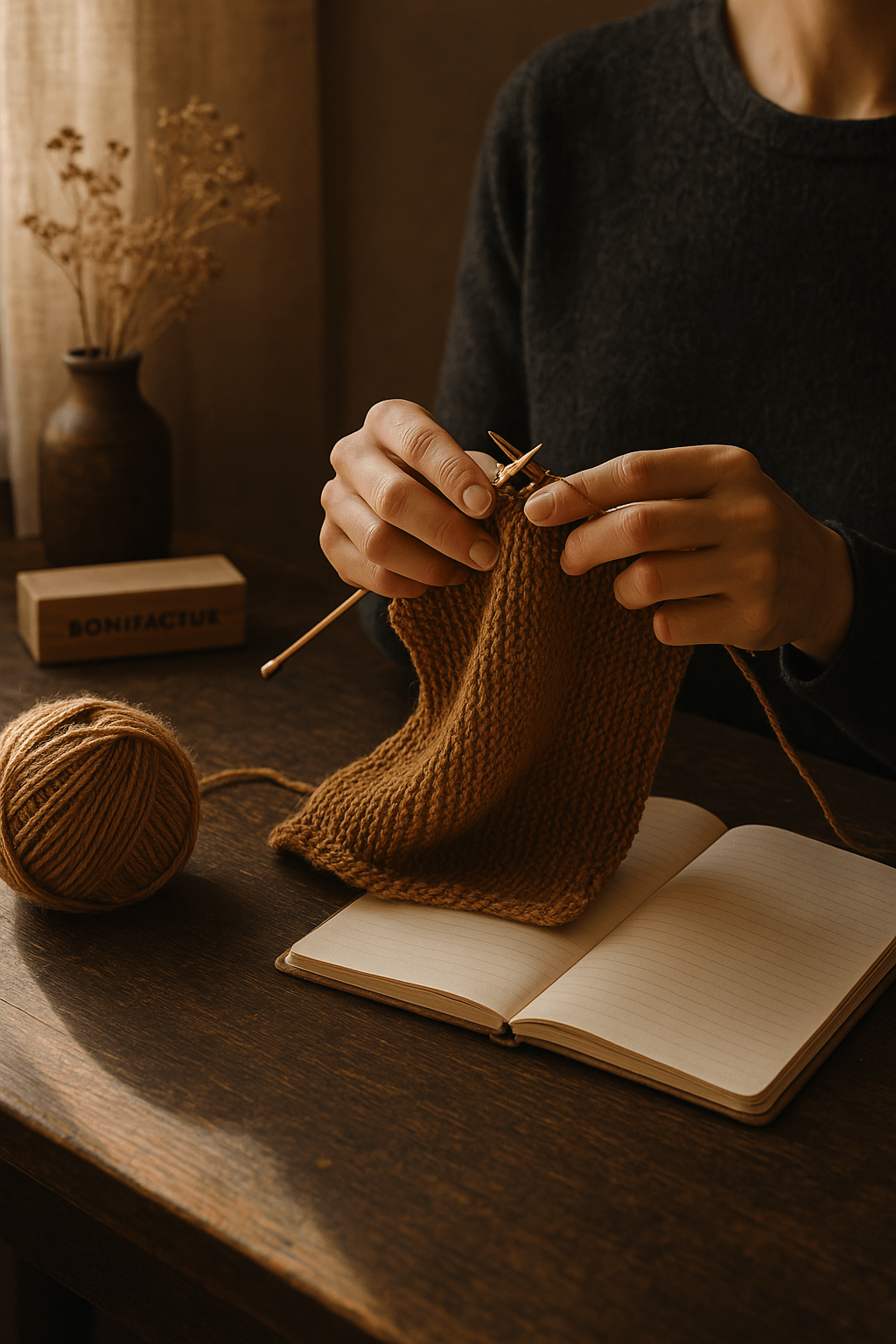
There is a moment in knitting when your hands find their own rhythm. When you no longer have to think about every stitch, but your fingers instinctively know what to do. You have reached this point – where technique becomes second nature and creativity can unfold.
At Bonifaktur, we believe true mastery lies not in complexity, but in deepening the simple. This article is for all those who have internalized the basic rhythm of knitting and are now ready to refine their craft – not to impress, but to serve the beauty that lives within them.
1. The Art of Conscious Material
As an advanced knitter, you already know that different yarns have different properties. But the true art is to consciously use these properties for your project.
Merino Wool breathes differently than Alpaca, Silk reflects light differently than Cotton. Each fiber carries its own story, its own sensuality. The master chooses not only what works or looks beautiful – she chooses what highlights the soul of a project.
Our tip: Work with yarn combinations that seem unconventional at first glance. A strand of ultra-fine Mohair with a strand of Silk not only gives unexpected texture but also a depth that cannot be achieved with a single yarn. Experiment with the contrast between matte and sheen, between volume and flow.
2. The Wisdom of Tension
Tension is the invisible architecture of every knitted piece. As an advanced knitter, you are aware of this – but how many of us regularly check not only our gauge but also our emotional tension while knitting?
The mood we knit in subtly transfers to our work. A piece made in haste carries that rush within it. One created in calm radiates that serenity. The master knows that tension lies not only in the hands but in the whole being.
Our tip: Consider your gauge not only technically but also emotionally. How do you feel while knitting? What quality do you want to weave into your piece? Sometimes it’s better to set the knitting aside when inner tension is too high – or to knit consciously then to transform that tension.
3. The Poetry of Negative Space
In Japanese aesthetics, there is the concept of "Ma" – the meaningful space between things. As a masterful knitter, you can apply this principle to your work. Not every knitting project has to be dense and complete. Sometimes it is precisely the consciously left space that gives a piece its special effect.
Experiment with openwork patterns not only as a technical exercise but as a deliberate choice for lightness. Let air and light flow through your work. True mastery is not always shown in what we add, but also in what we leave out.
Our tip: Study traditional lace patterns from various cultures and observe how they play with the balance of fullness and emptiness. Transfer these principles to modern designs. A simple garment with strategically placed openwork elements can be more powerful than a continuously complex pattern.
4. Understanding the Depth of Colors
Color is more than aesthetics – it is psychology, cultural history, personal memory. As an advanced knitter, you can begin to work with colors on a deeper level. Not just what pleases, but what moves.
The master understands that certain shades come forward while others recede. That some colors activate, others soothe. She knows the subtle differences between a gray with a bluish undertone and one with warm beige in it. And she uses this knowledge not for effects, but for expression.
Our tip: Create a personal color collection – not just from yarn samples, but from all materials that appeal to you. Fabrics, papers, natural materials. Observe which Color Combinations repeatedly attract you. Deepen your understanding not only of colors themselves but of their relationships to each other. Sometimes it is the inconspicuous transition tone that gives a color composition its soul.
5. The Heritage of Craftsmanship
In an age of unlimited online tutorials and instant information, there is special value in studying traditional knitting techniques from various cultures. Not as a folkloric exercise, but as a connection to a long line of artisans who came before us.
Estonian lace, Persian pattern diversity, Nordic stars – behind every traditional pattern stands not only a technique but a worldview. The master understands that she is part of a continuum and honors this heritage by keeping it alive and carefully developing it further.
Our tip: Choose a traditional knitting technique that particularly attracts you and study it in depth. Not only the patterns themselves but also their cultural context. What were the living conditions of the people who developed this technique? What materials were available to them? What symbolic meaning did certain patterns have? This understanding will enrich your own work with a depth that goes beyond pure aesthetics.
6. The Elegance of Construction
Advanced knitters understand that a truly successful piece must be thought of from the inside out. Construction – how stitches increase and decrease, how parts are joined, how the piece ultimately fits the body – is not just a technical detail but crucial for the integrity of the whole work.
The master knows that an invisible transition, a perfectly placed decrease row, a well-considered neckline contribute as much to beauty as the most striking pattern. She understands that true elegance often lies in the details no one sees.
Our tip: Study the construction principles of garments, not only in the knitting world. How are well-fitting tailored clothes built? Which architectural principles can be transferred to knitting? Experiment with unconventional constructions – from the center outwards, from top to bottom, diagonal. Sometimes an unusual construction method leads to a piece that looks especially natural.
7. The Wisdom of the Hand
In an increasingly digitalized world, a revolutionary act lies in the conscious decision to work with the hand. As an advanced knitter, you know the meditative quality of knitting, but you can deepen this awareness even more.
The master understands knitting not only as a way to create something but as a practice of presence. Every stitch becomes an opportunity to be fully in the moment. The finished piece carries not only the marks of her technical skill but also her accumulated attention.
Our tip: Experiment with mindful, slow knitting. Choose a special project and devote your full attention to it – no podcasts, no TV, no distractions. Feel every movement, the glide of the yarn between your fingers, the rhythm of the needles. This deep connection to the process itself will imbue your work with a quality that cannot be measured in technical terms.
8. The Freedom of Improvisation
One of the greatest joys for the advanced knitter is the moment when she can break free from Patterns and follow her own creative impulses. No longer "playing by the notes," but freely improvising – that is mastery.
This does not mean every piece must be completely reinvented. As in music, improvisation in knitting can build on solid foundations. The master understands the rules so well that she knows when and how to break them – not out of carelessness, but out of creative necessity.
Our tip: Start with small improvisations. Take a familiar Pattern and consciously change one element – a different collar, a modified sleeve construction, an added pattern. With every deliberate intervention in an existing structure, your confidence in your own creative voice grows. Over time, you may find you no longer need complete Patterns – only inspirations that you translate into your own knitting language.
9. The Attitude of the Eternal Student
Paradoxically, one of the signs of true skill is the realization of how much there still is to learn. The master knows that mastery is not a goal but a path. She preserves the curiosity and openness of a beginner, even though her hands already show the confidence of years of practice.
This attitude prevents stagnation and continually opens new horizons. It allows learning both from the eighty-year-old knitting grandmaster and from the young designer who brings fresh perspectives.
Our tip: Regularly challenge yourself with something new – a technique you don’t yet master, a material you haven’t worked with, a style that doesn’t match your usual aesthetic. These conscious steps out of your comfort zone keep not only your technical skills alive but also your creative curiosity. The willingness to be a beginner again and again is perhaps the greatest gift you can give yourself as an experienced knitter.
At Bonifaktur, we believe true beauty arises when hands and heart work together. As an advanced knitter, you have mastered the technical basics – now the path is open to develop and refine your very own knitting voice.
We see our role not as telling you what to knit, but accompanying you on your creative journey. With materials that honor your mastery. With colors that appeal to your senses. With a space where your art can unfold – at your own pace, by your own standards.
Welcome to Bonifaktur – where every stitch is a choice for beauty.
Yarn with soul. For people with heart.
Color Stories: How Colors Influence Our Knitting Projects and Our Mood
Why hand-dyed Yarns are more than just Color