


This First Stitch That Changes Everything
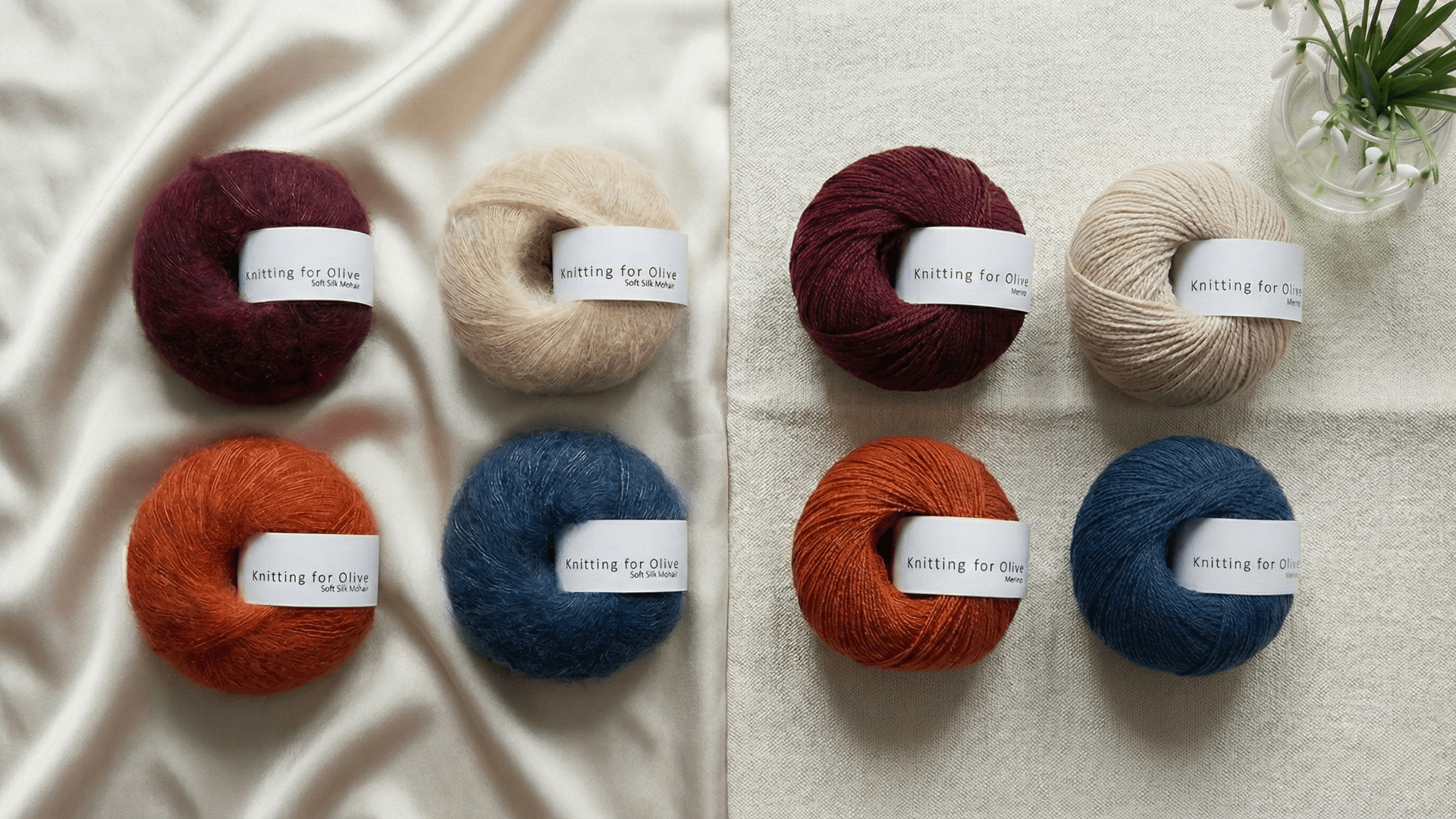
There are moments in knitting after which you never want to go back. When two threads glide together through the needle and the resulting piece feels like a second skin—at once feather-light and warm like a hug. That’s exactly what happens when you knit Knitting for Olive Soft Silk Mohair together with Knitting for Olive Merino.
This combination is no accident. It’s the result of two yarns from the same design house created to complement each other. The Merino brings body, crimp, and color. The Soft Silk Mohair lays over it like a delicate veil of light. What emerges is more than the sum of its parts—and once you’ve experienced it, you hardly knit any other way.
What’s in the Yarns? The Fibers Behind the Magic
Knitting for Olive Soft Silk Mohair: Feather-light with Silk
The Soft Silk Mohair is made of 70% Kid Mohair and 30% Silk—and this blend is what makes it special. Kid Mohair comes from young Angora goats and has extremely long, smooth fibers. These fibers barely tangle with each other; they dance freely around every stitch, creating the characteristic Halo—that glowing corona that transforms every knit piece into something dreamy.
The silk enhances this effect even more: it gives the fine fibers a cool sheen and makes the yarn pleasantly soft against the skin. 25 g is enough for 212 m of yarn—a tiny ball with incredible yardage and a color palette of over 90 tones, from delicate Snowflake to rich Bordeaux.
Knitting for Olive Merino: Color, Substance, Crimp
Knitting for Olive Merino is the counterpart: a classic, pure Merino wool in fingering weight, with its natural crimp—the fine waviness of the fiber—providing bounce, warmth, and a clear, readable stitch definition. It holds its shape, gives the knit piece substance, and carries color in that characteristic Nordic richness Knitting for Olive is known for.
Together, this means: The Merino defines the stitch, the Mohair makes it dreamy.
Why This Combination Works So Well—A Brief Explanation
Mohair alone is beautiful but demanding. Without a structured companion yarn, the stitches are hard to read, mistakes are difficult to fix, and the yarn lacks stability. The Merino solves exactly these problems: it gives the Mohair something to anchor to, keeps the stitch definition stable, and ensures the finished knit doesn’t collapse like cotton wool.
The Mohair, in turn, gives the Merino what it can’t do alone: that second dimension, that depth. Colors under the Halo look like they’re seen through frosted glass—more intense, nuanced, alive. A blue Merino remains blue, but through the Mohair it gains something atmospheric. A warm terracotta glows like in evening light.
Just try it: knit a few stitches with Merino alone—beautiful, precise, warm. Add the Soft Silk Mohair. The same stitch, but suddenly it has a third dimension.
How to Knit the Two Yarns Together: Step by Step
1. Choose Needle Size
The rule of thumb: go one to two sizes above the recommended needle size for the Merino. This gives the Mohair room to develop its Halo. For KfO Merino, 4.5 to 6 mm needles are usually recommended in combination, depending on the desired drape and project.
2. Prepare the Threads
Place each ball in a separate cup or yarn basket to prevent tangling. Hold both threads together and knit them as one. After a short time, it feels completely natural.
3. Knit a Gauge Swatch—Really
Mohair doesn’t forgive later corrections. The long fibers tangle when picking up or dropping stitches, and the yarn is hard to separate. A careful gauge swatch of at least 15 × 15 cm is not just a formality here but a real time saver.
4. Maintain Tension—and Trust the Yarn
Before washing, the stitch definition often feels loose and unfinished. That’s normal. Mohair only fully opens up through washing. So don’t knit tighter than necessary—you’ll only make it worse.
5. Washing & Blocking: Where the Real Magic Happens
Gently wash the finished knit in lukewarm water with a mild Wool Wash, press out the water (never wring!), and lay flat to dry. The Halo will fully develop now, the fibers open up—and the finished result looks like it came from a professional designer.
Combining Colors: Your Most Creative Playground
This is where it gets really beautiful. You can choose tonal Color Combinations—Mohair and Merino in similar shades that flow into each other. Or play with contrast: a warm Merino in terracotta with a cool Mohair in Dusty Violet, or a deep navy Merino with an icy Snowflake Mohair over it.
Because both yarns come from the same house and follow the same color philosophy, the tones almost always harmonize—no matter which combination you choose. If you’re still unsure, just check out our Knitting for Olive Color Combinations page. There you’ll find curated pairings we’ve put together for you—from gentle monochromes to bold color clashes.
What Can You Knit With It?
Oversized Sweaters
The duo of Merino and Soft Silk Mohair is made for oversized designs. The finished knit is surprisingly light for its visual volume—comfortable to wear without being too heavy. Ideal for raglan cuts and wide, draped silhouettes.
Shawls & Scarves
Mohair shows its Halo best in open patterns: yarn-overs, lace patterns, large stitches. A simple rectangular shawl in Seed Stitch or a plain lace pattern gains a completely different quality through this duo.
Hats & Accessories
Those with sensitive skin appreciate the Merino as a buffer here. The Soft Silk Mohair lies softly without itching—and the result looks like it came from a Parisian atelier.
If You’re Looking for an Alternative: Gepard Kid Seta
You may have already discovered the Gepard Kid Seta—also a Kid Mohair-silk yarn, also laceweight, with its own color palette of 70 tones. It’s a lovely alternative if you want a different color world or a second pair of yarns for a larger project. The basic principle—Mohair + Merino, held together—works just the same.
Frequently Asked Questions (FAQ)
Can I knit Mohair alone? Yes, but it requires patience. Mistakes are hard to fix and the stitch definition is difficult to read. As a companion to a structured Merino, Soft Silk Mohair is much easier to handle—and the result is noticeably more beautiful.
Is Kid Mohair soft enough for direct skin contact? Kid Mohair is considered significantly softer than regular Mohair. Combined with Merino, it feels very comfortable. For very sensitive skin—such as around the neck—a test is still recommended. Compared to classic Mohair, the difference is substantial.
What needle size do you recommend? For KfO Merino + Soft Silk Mohair together: about 4.5–6 mm, depending on the project. For scarves and shawls, rather loose (5.5–6 mm); for sweaters with more structure, a bit tighter (4.5–5 mm). Always knit a swatch.
Can I separate the yarns if I make a mistake? If you notice immediately that something is wrong: yes, with a lot of patience. If the Mohair has been in contact with the Merino for longer, it becomes difficult. So always: knit slowly and check your work regularly.
Come and Knit
Soft Silk Mohair comes in over 90 colors. KfO Merino has its own complete spectrum. And the overlap between the two—the color world that emerges when you bring the right tones together—is almost inexhaustible.
If you want to know which combinations work especially well, check out our Color Combinations page. Or trust your gut, try two tones that speak to you—and knit a swatch.
Sometimes that’s the best way to find the perfect pair.
Enjoy! 🧶
KFO Merino vs. Heavy Merino: Which Yarn for Which Project?
Knitting for Babies: What You Need to Know About Yarns, Projects, and Safety